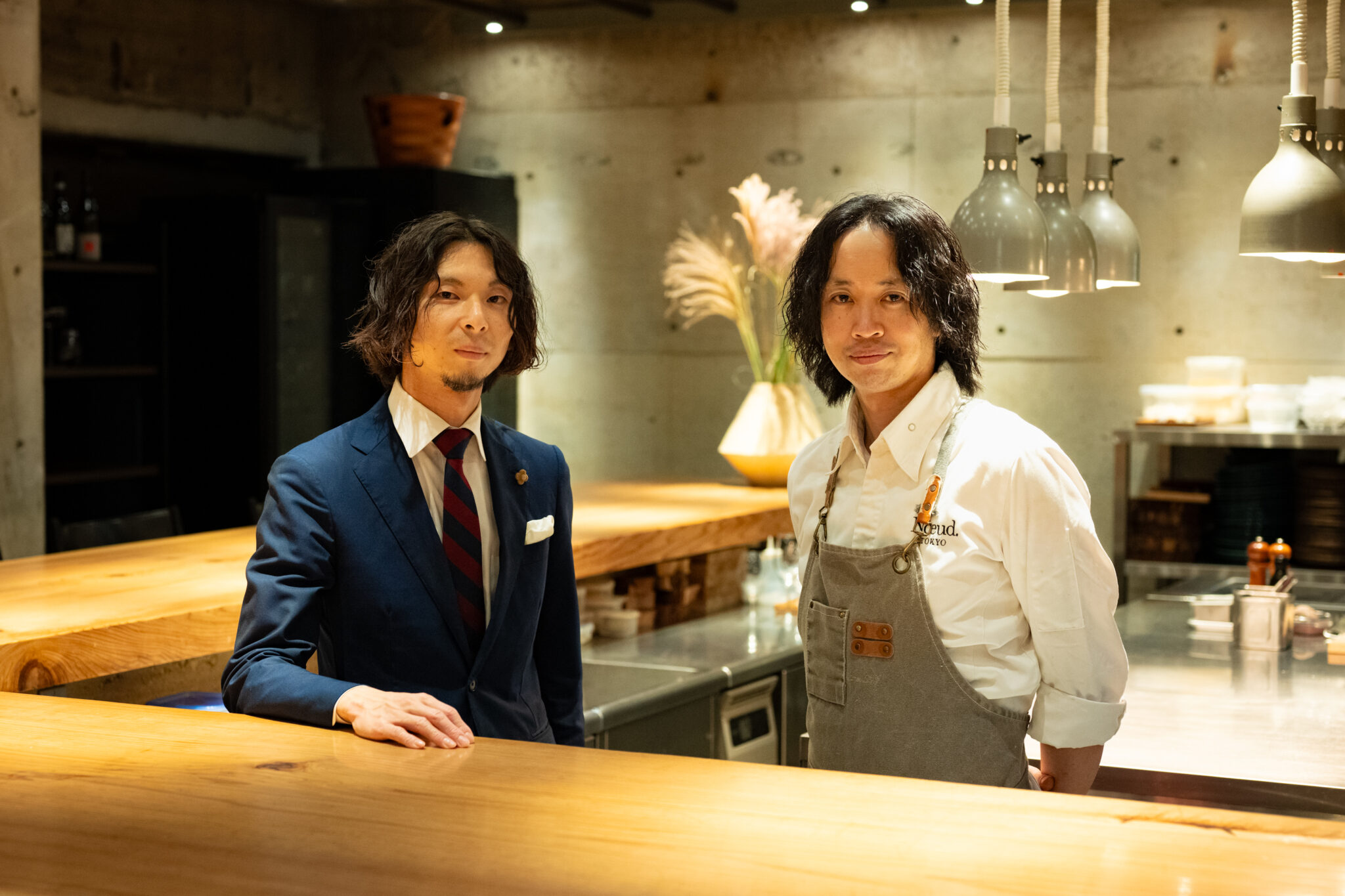
Nœud.TOKYO is a restaurant that is exploring the true essence of sustainability.
Located in Kioicho, Chiyoda Ward, in the heart of Tokyo the restaurant champions a new food culture in which every element, from ingredient selection, cooking techniques, interior design and tableware adheres to an “all sustainable” philosophy. Since its opening, Nœud.TOKYO has been awarded the Michelin Guide Tokyo Green Star for five consecutive years.
The name Nœud, meaning “knot,” “connection,” or “bond” in French, reflects the restaurant’s aspiration to serve as a point of connection which links nature, society, people, and the environment through food.
At the center is Chef Naoto Nakatsuka whose cuisine embodies his distinctive philosophy and refined craftsmanship. Alongside him is Chef Sommelier Kei Miyauchi whose exquisite pairings compliments the cuisine and elevates the experience. Together, their collaboration unfolds like a musical duet. To uncover the inspirations behind their work and the process through which their creations take shape, we spoke with them about their passion for food and drink, and the stories that inform their craft.
“All Sustainable” the key behind enjoying various ingredients to the fullest
Just a few minutes walk from Nagatacho Station, Nœud.TOKYO is tucked away in a quiet basement of a building.
Passing through the simple glass entrance, which was retained from the previous establishment and permeates a touch of nostalgia, you step into a refined space defined by soft grey earthen walls. These walls were created using banchiku, a traditional rammed-earth construction method. The earth itself was recycled from Jurakutei, an old storehouse in Kyoto near the former site of Jurakudai, the political center and residence built by Toyotomi Hideyoshi during the Azuchi–Momoyama period.
Moving through the narrow earthen corridor, your gaze is drawn to a striking counter table made from a single slab of solid wood, set before an open kitchen. The wood was sourced from a temple in Aichi Prefecture, using trees that had been felled for safety reasons. Surrounded by earth and wood, the space radiates a quiet, natural warmth, and it is like being in nature even while being in the very heart of the city.
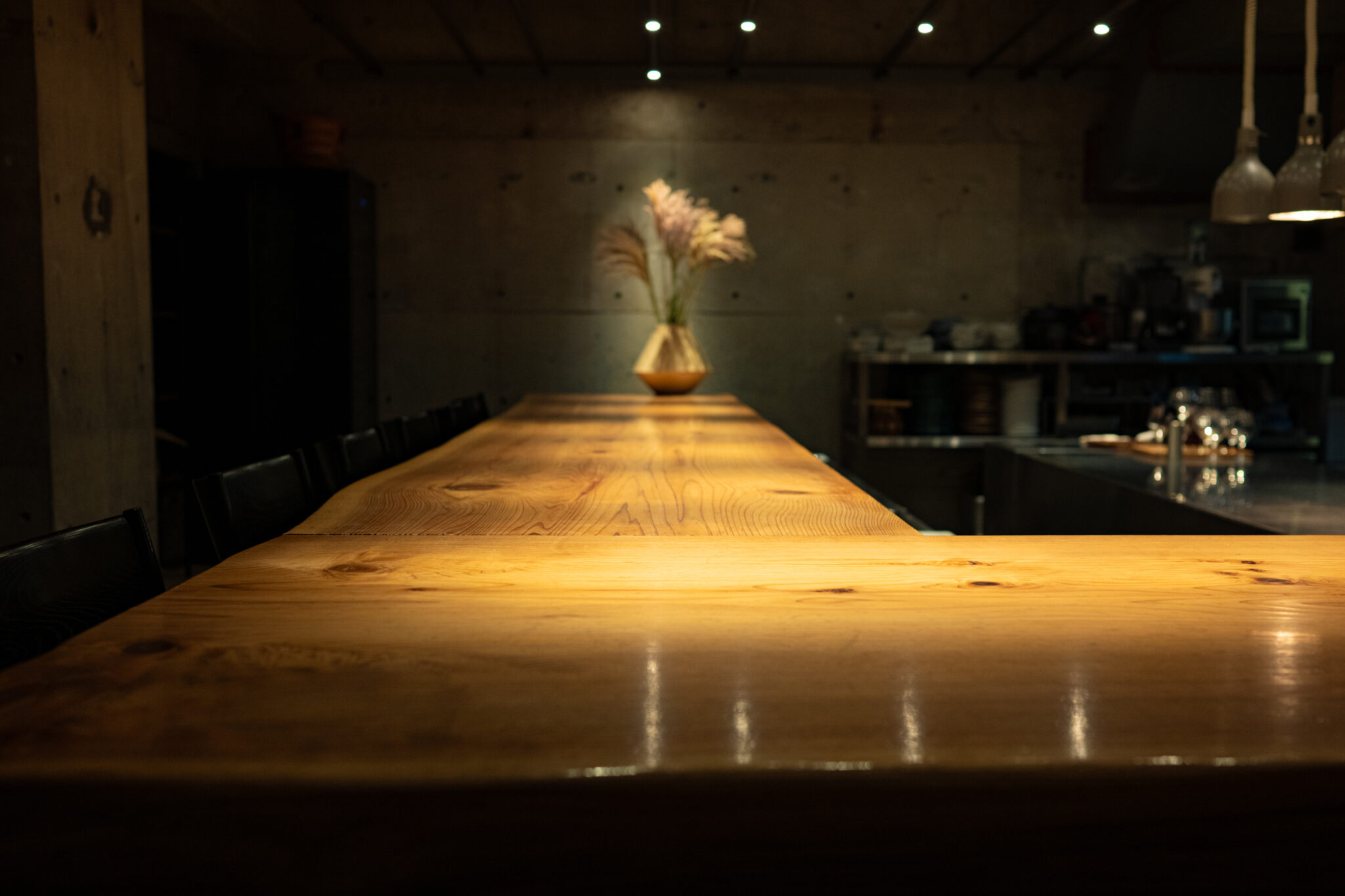
Every detail is carefully considered, from the traditional crafts that grace the table, of Imabari towels from Ehime, cutlery from Tsubame-Sanjo in Niigata, to knives from Echizen Uchihamono in Fukui. None of these elements demand attention on their own; instead, their exceptional quality and quiet comfort reveal themselves through use.
Ingredients at Nœud.TOKYO are used in their entirety, from skin to roots, bones to trimmings—minimizing waste and honoring the life of each element.
Nakatsuka’s dishes unfold in delicately layered flavors and aromas, resonating like harmonies to create depth and complexity. His respect for the land is evident in every bite, as each ingredient’s essence is drawn out and expressed in its fullest form.
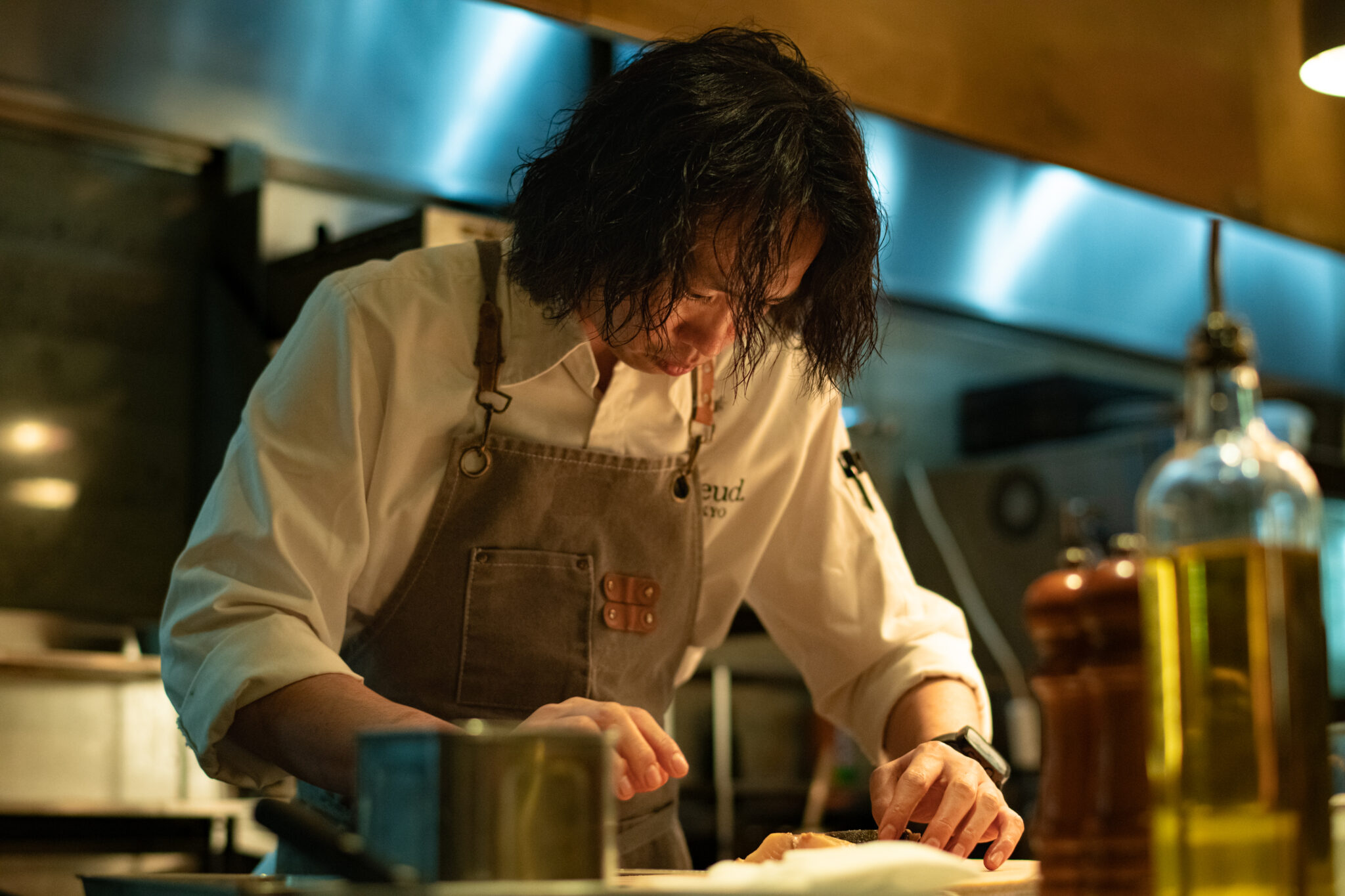
Nakatsuka explains, “Even within a single ingredient, the leaves, fruit, and roots each have their own distinct character. I want my dishes to reveal that range of flavors and share that joy with our guests.”
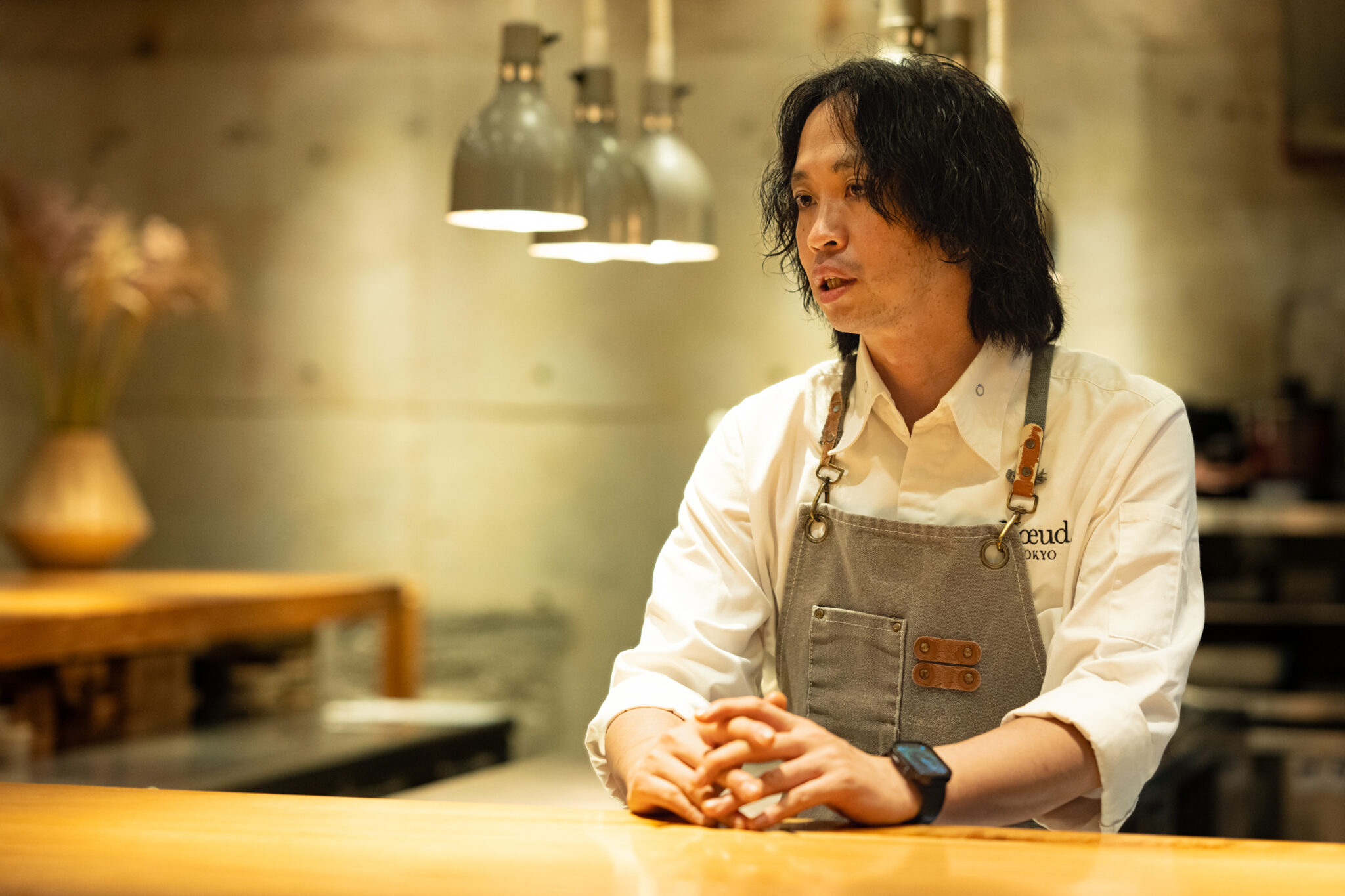
“I often visit our producers in person, and because every ingredient we receive is edible, wasting any part of it would feel disrespectful to both the producers and the ingredients themselves. I’m always thinking about how to transform every element into something delicious, whether that means drying fruit peels or making broth from scraps. I use it all. That said, I don’t consider this approach anything special. It’s simply what feels natural and expected.”
There is much he could explain about the ingredients, yet Nakatsuka never overstates or overexplains. When asked, he is generous in sharing his knowledge, but his foremost wish is simple and that is that guests enjoy the food and feel at ease to enjoy the experience.
Completing the experience are the drink pairings by Miyauchi, an essential element of dining at Nœud.TOKYO.
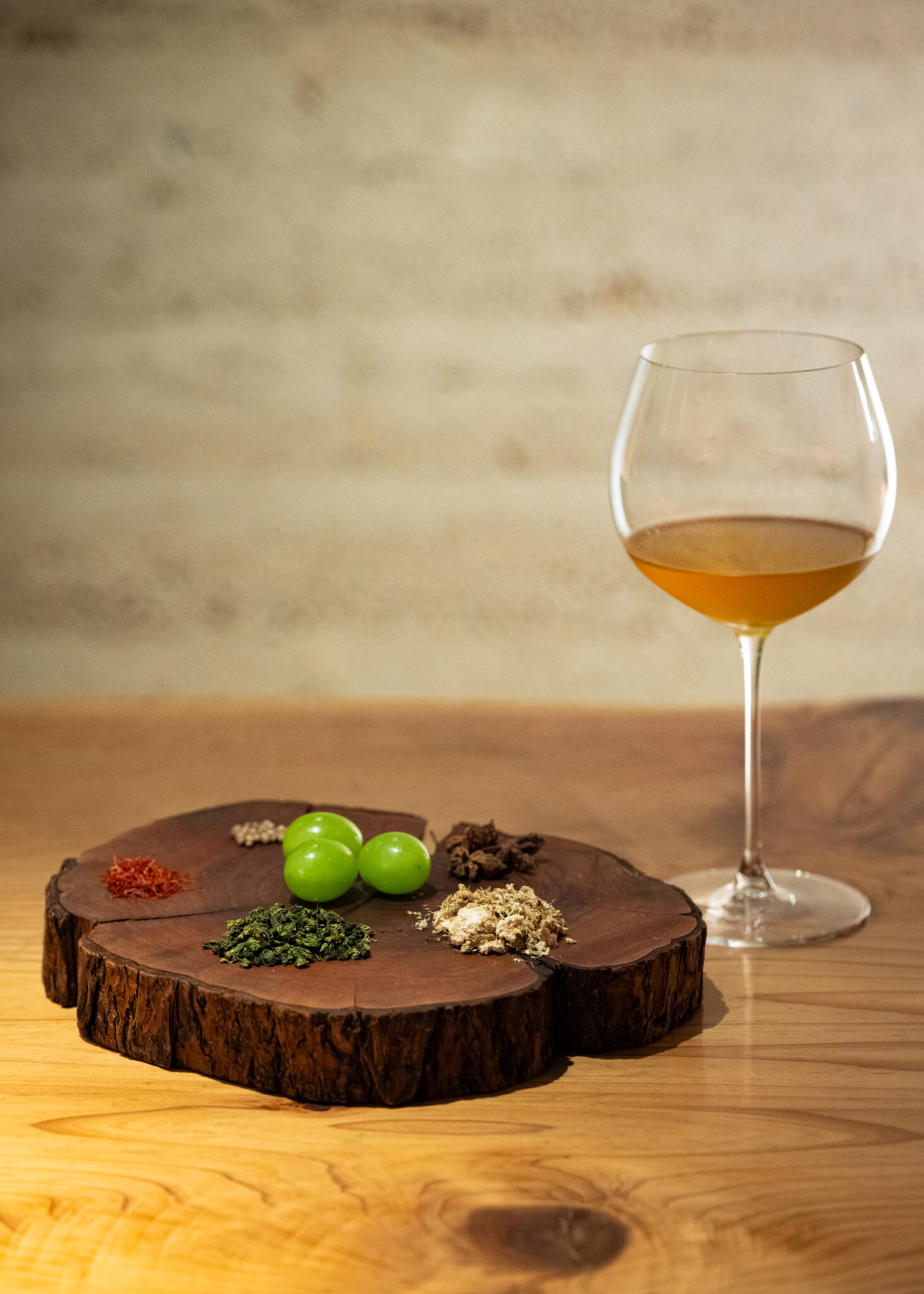
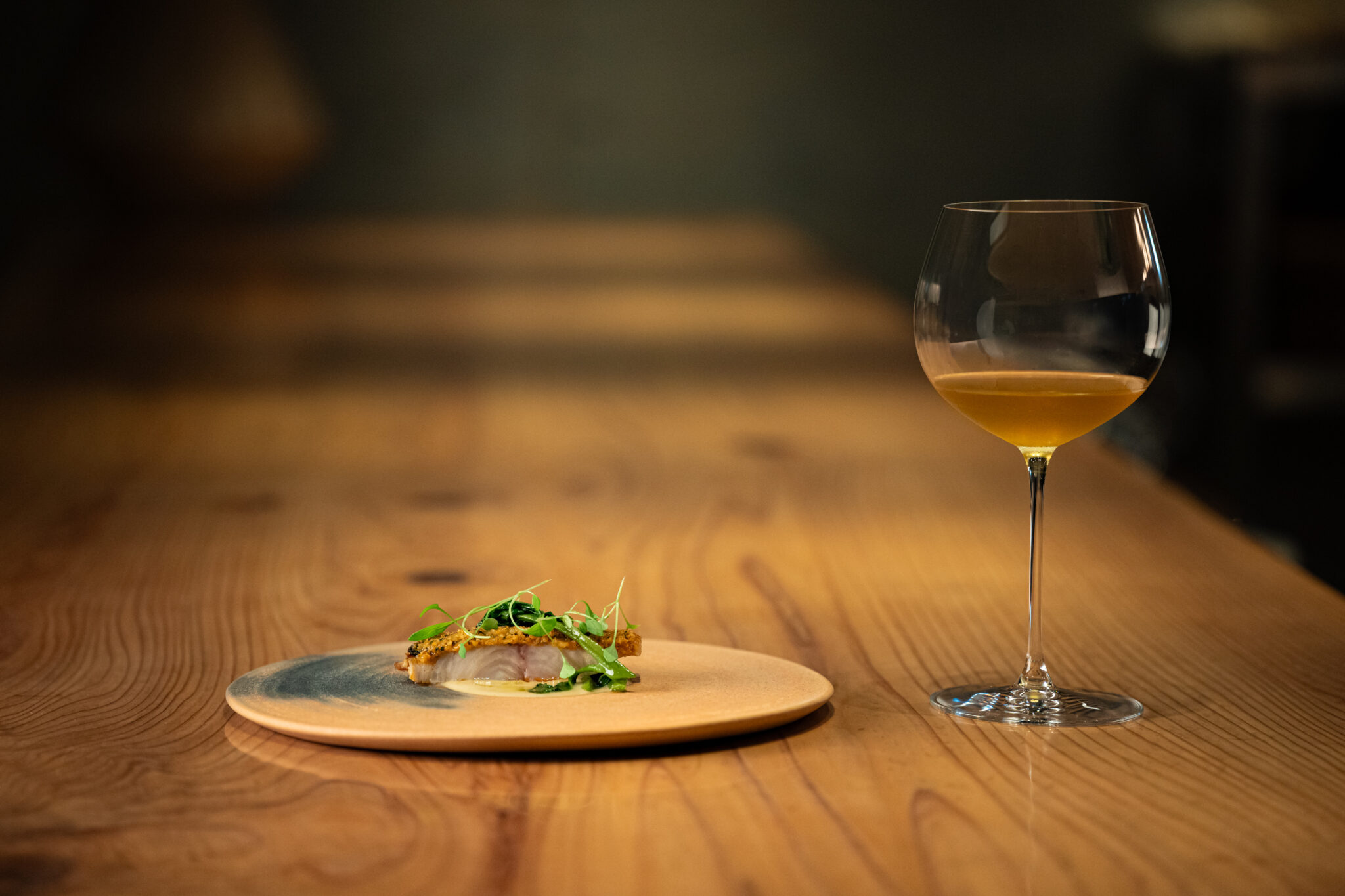
While the wine selection is undeniably superb, what truly stands out is the exceptional quality of their original non-alcoholic drinks. Experiencing these creations often comes with a moment of genuine surprise.
Rooted in the same sustainability philosophy as the cuisine, these drinks make thoughtful use of ingredient components not used in the kitchen, transforming them through careful processing and blending. The result is a series of pairings that naturally complement the dishes while revealing complex aromas and layered flavors which offer a depth and structure that rival that of wine.
It is not uncommon for customers here who usually drink alcohol to choose the non-alcoholic options instead. The pairing experience crafted by the two of them broadens the horizons of culinary enjoyment.
The story of how the “all sustainable” restaurant came to be
From an early age, Nakatsuka found joy in cooking. He grew up in Ehime, surrounded by abundant nature, watching his grandmother tend a vegetable garden. His mother was also an excellent cook, and their home was filled with cookbooks.
While still in elementary school, Nakatsuka began cooking for himself, turning to those cookbooks when his parents were away or on weekends. By junior high school, his aspiration to become a chef had already taken shape. Without hesitation, he chose to attend culinary school in Osaka to pursue his dream. There, he recalls that the hands-on training classes were nothing but fun and deeply engaging.
A pivotal shift in his approach to ingredients came later, while working as a chef at a wedding venue. He received a request from a guest to use a specific onion for a reception dish. Upon tasting it, he was struck by its exceptional flavor. Compelled to learn more, he visited the onion farm on Awaji Island and was deeply moved by the story behind it.
“The farmer told me that his children used to dislike vegetables. In an effort to help them enjoy eating vegetables, he gradually reduced pesticide use and eventually transitioned to organic farming. After countless trials to improve both quality and flavor, the children finally began to eat and enjoy the vegetables.”
“That experience made me realize what farming truly is. It also reinforced my belief that, as a chef, it is my responsibility to respect ingredients grown with such care and pride, and to serve them in a way that allows them to be even more delicious.”
At the time, the word “sustainable” was not yet widely used in Japan. Even so, Nakatsuka began deepening his relationships with producers, communicating more with the producers and visiting their farms. Even now, he takes the restaurant staff to meet the producers in person.
“Producers often talk about how the oceans, mountains and land we have today are borrowed from the future generations so they must be protected. Learning from them strengthened my resolve to create a restaurant that supports a healthier and more sustainable food cycle.”
Nœud.TOKYO opened in 2020, in the midst of the coronavirus pandemic. It was undeniably a challenging time for the restaurant industry, yet Nakatsuka reflects that the period gave him the opportunity to deeply consider what sustainability truly means.
As he delved deeper into how he wanted his restaurant to be, he was able to carefully consider each component and create a space that was unlike any other.
An encounter with a non-alcohol drinking customer that inspired new possibilities in a sommelier
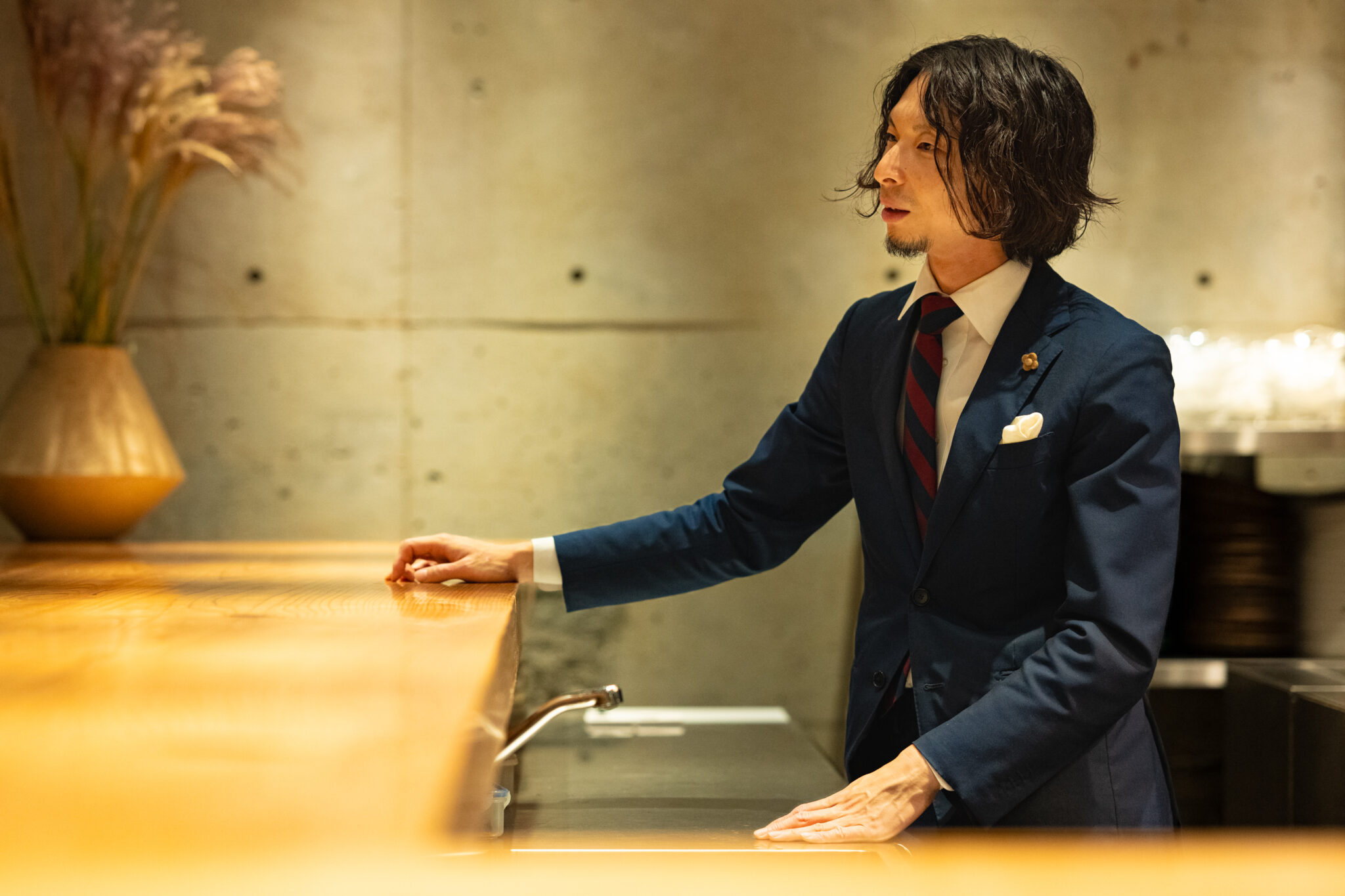
Nakatsuka’s partner and Chef sommelier Kei Miyauchi is from Niigata Prefecture. He grew up surrounded by rice and vegetable farms, in a community and culture where caring for the natural environment was simply a part of everyday life. A lover of music, he dreamed of running a casual music bar where people could enjoy good music alongside drinks. At the time, however, he knew very little about alcohol.
“My knowledge of alcoholic drinks was almost nonexistent back then. Wanting to learn properly about wine and beverages, I decided to work at an Italian restaurant with a very strict head chef. I did not have any grand ambitions at first, and because I was so inexperienced, the work was extremely stressful. Still, I am naturally persistent, and little by little I began to appreciate wine and to find joy in the work of serving customers.”
Miyauchi later deepened his knowledge and curiosity while working at the modern French restaurant L’Argent, a renowned establishment that has consistently earned Michelin stars. The wines selected by the restaurant’s sommelier, who also became Miyauchi’s mentor, astonished him with their depth and precision. He recalls being struck by just how extraordinary the pairings were.
At the time, Miyauchi felt he had yet to encounter a sommelier whose sense of pairing surpassed that of his mentor. At the age of 29, he underwent a shift in perspective and resolved to devote his life to the profession.
At the same time, he also encountered moments that made him aware of his own limitations.
One such moment involved a regular guest at L’Argent who loved dining out but was unable to drink alcohol. At the time, non-alcoholic options were largely limited to tea or simple soft drinks. Miyauchi found himself frustrated by the fact that he could not offer this guest the same joy of pairing that others experienced.
Although non-alcoholic pairings were beginning to attract attention in certain fine dining circles, Miyauchi could not imagine creating original drinks himself. He believed it was something only a sommelier with exceptional and specialized skills could achieve.
Still, driven by curiosity, he decided to experiment with non-alcoholic pairings for a special event. The regular guest attended and tasted one of Miyauchi’s creations. The guest’s reaction was pure delight.
“Looking back now, I don’t think the drink I made was particularly refined. But seeing how much joy it brought to that guest sparked my desire to seriously explore the world of non-alcoholic drinks.”
In fact, Chef Nakatsuka doesn’t drink much alcohol himself. Miyauchi says this fact further fueled his desire to explore non-alcoholic drinks.
“Chef loves dining out but can’t drink alcohol and he reminded me of the regular customer at my previous job. As we dined out together exploring various restaurants and ideas, I decided that at Nœud I would serve original non-alcoholic drinks that the chef himself could truly enjoy as well.”
Miyauchi once thought that a sommelier’s career path was quite limited.
“I used to think that a sommelier’s career is defined by winning competitions, working at Michelin-starred restaurants and becoming a chef sommelier of a grand maison. However, meeting my mentor made me realize that although I have a deep love for wine, I was not cut out for the traditional career path of a sommelier. (laughs)”
“So perhaps I came to this restaurant in order to explore how I could express the job of a sommelier in my own way. I think about what it is I truly want to share through wines and drinks and what expresses my own authenticity. Although I cannot quite articulate it clearly right now, I think creating non-alcoholic drinks is a part of it.”
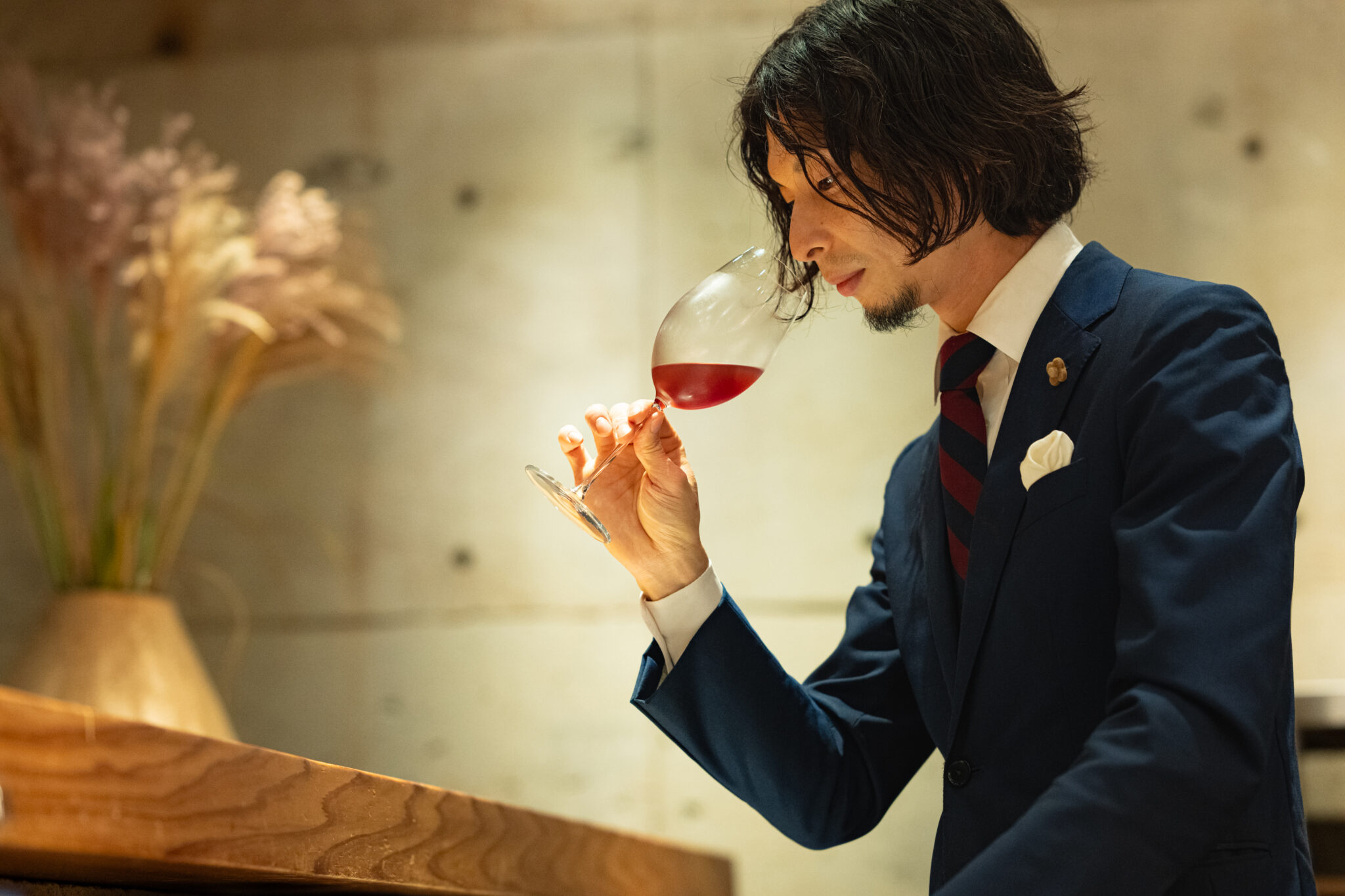
Pairing to find the perfect drink to complement the dish
“Creating new drink recipes feels like research, but it also feels like play,” Miyauchi says with a cheerful smile.
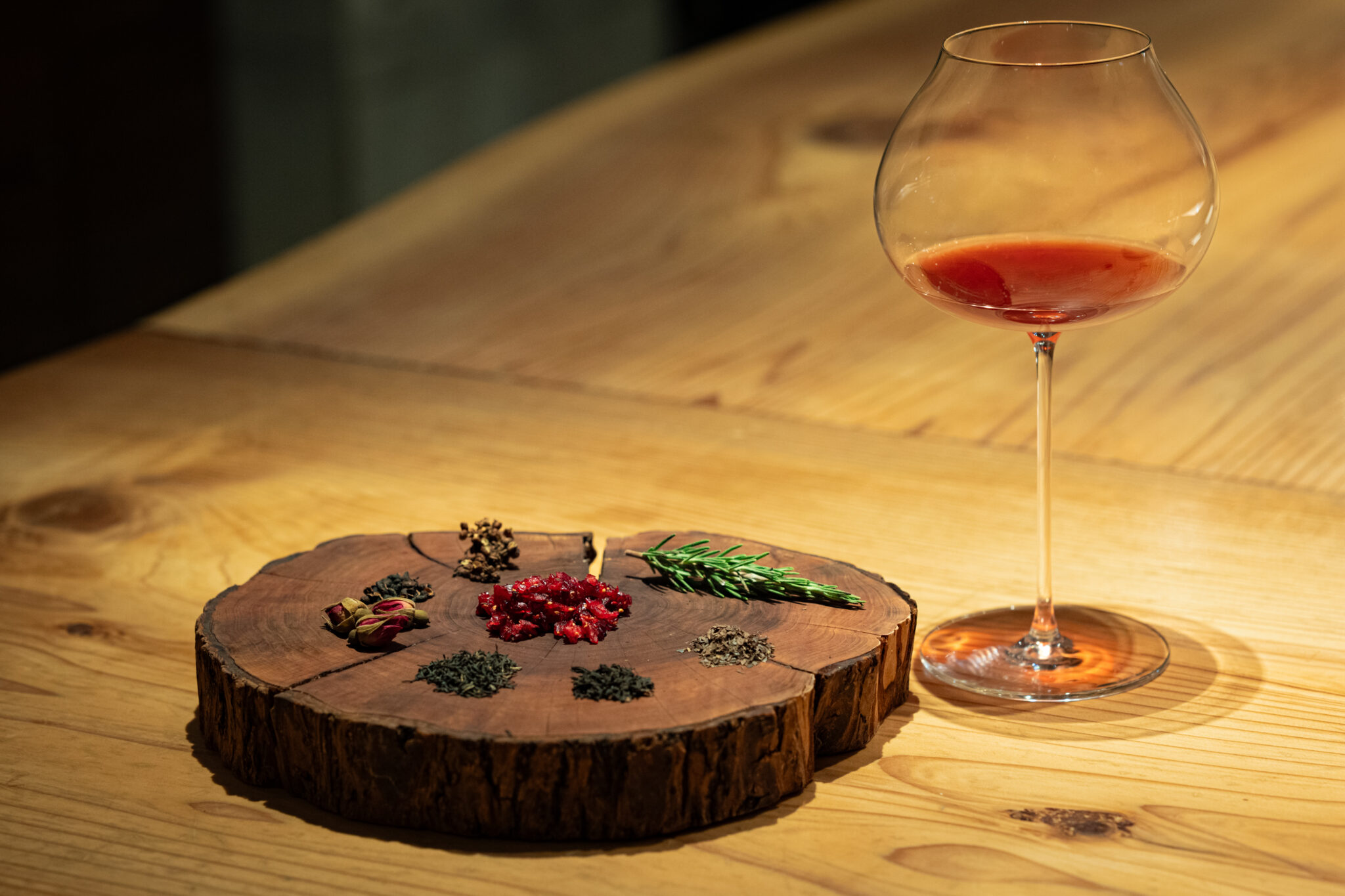
He explains that Nakatsuka often helps prepare ingredients for the drinks as a natural extension of his cooking. For example, when fennel is used in a dish, the tougher, inedible parts are pressed to extract a surprisingly flavorful liquid. The remaining pulp is then dried and turned into an extract, creating a profile well suited for blending into drinks.
In this way, ingredient parts not used in cooking, such as peels and roots, are simmered, dried, or powdered and repurposed for beverages. Fruits harvested on farms that do not meet market specifications and therefore cannot be sold are often especially well suited for drink-making, adding nuanced accents of flavor.
As Miyauchi puts it, “We have a wonderful working environment where the chef and staff are always naturally thinking about how to make use of every ingredient, whether it is finding a fragrant part of a leaf for syrups or drying unused vegetable trimmings.”
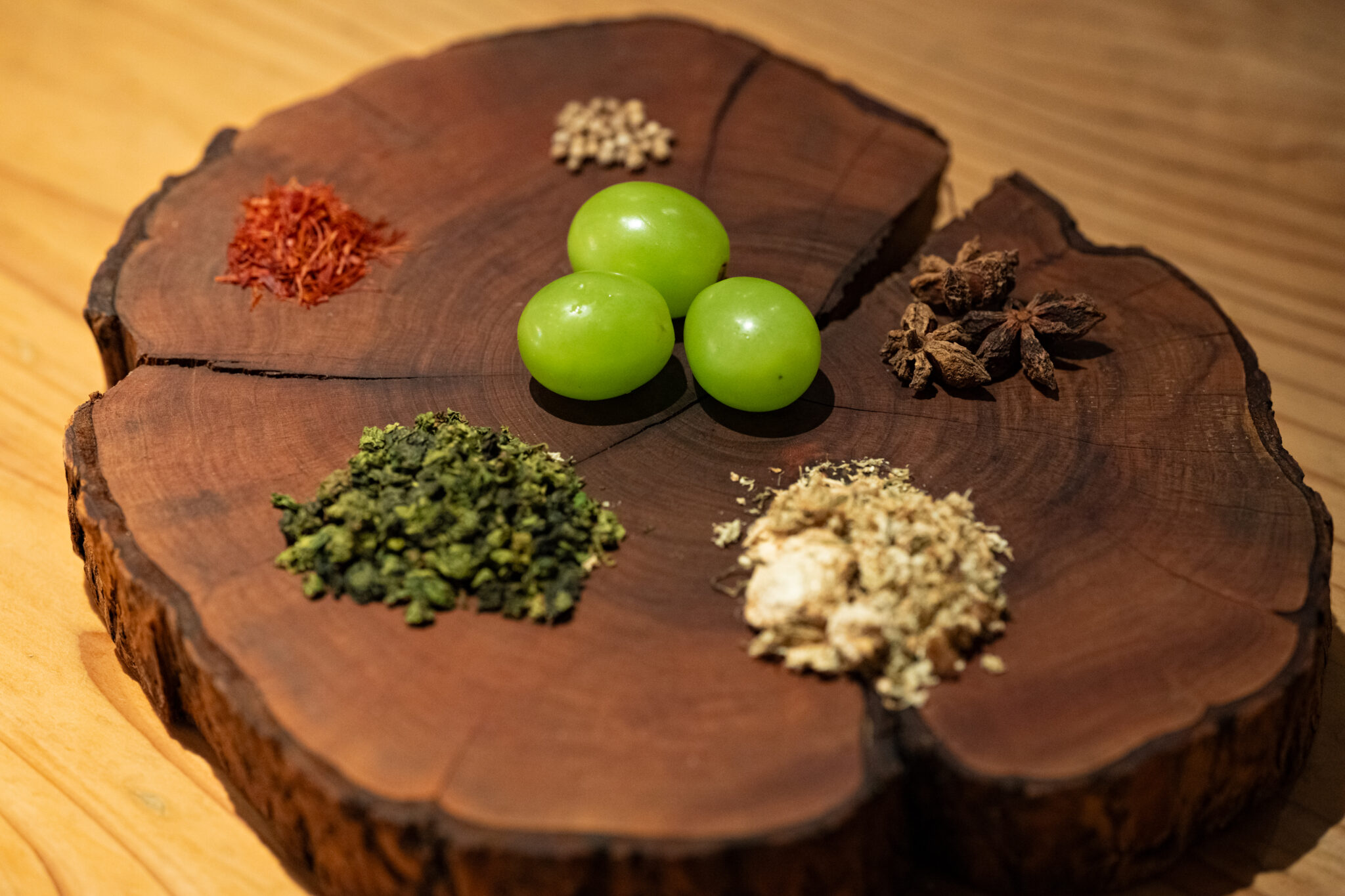
With both food and drink evolving side by side, ingredients are never wasted and ideas continue to multiply, creating an environment that encourages boundless creativity. We asked Miyauchi about his approach to pairing.
“Although I receive help in preparing ingredients, I do not consult with the chef when deciding on pairings. The chef creates a perfect dish, and my role is to provide a drink that complements it. I truly love this way of working.”
“I do not want to think in a way that removes or alters elements of a dish in order to fit a wine pairing. A dish should never be compromised for the sake of pairing. The chef’s dish must be complete in itself. Only then can I respond to its true potential with the right wine or drink.”
“That is why we do not decide together. My responsibility is to serve the highest-quality drink alongside the chef’s perfect dish. I am fully dedicated to that purpose.”
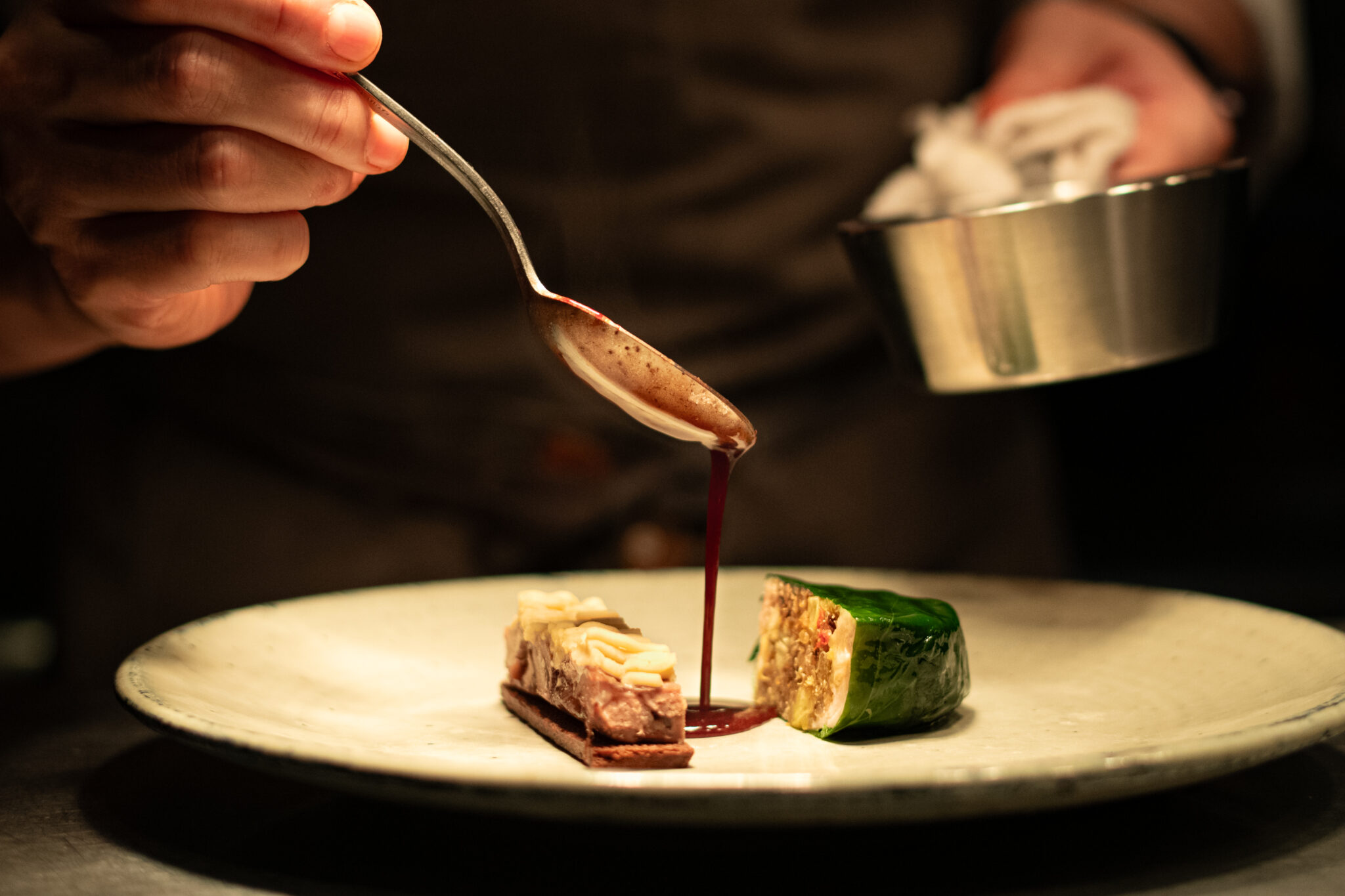
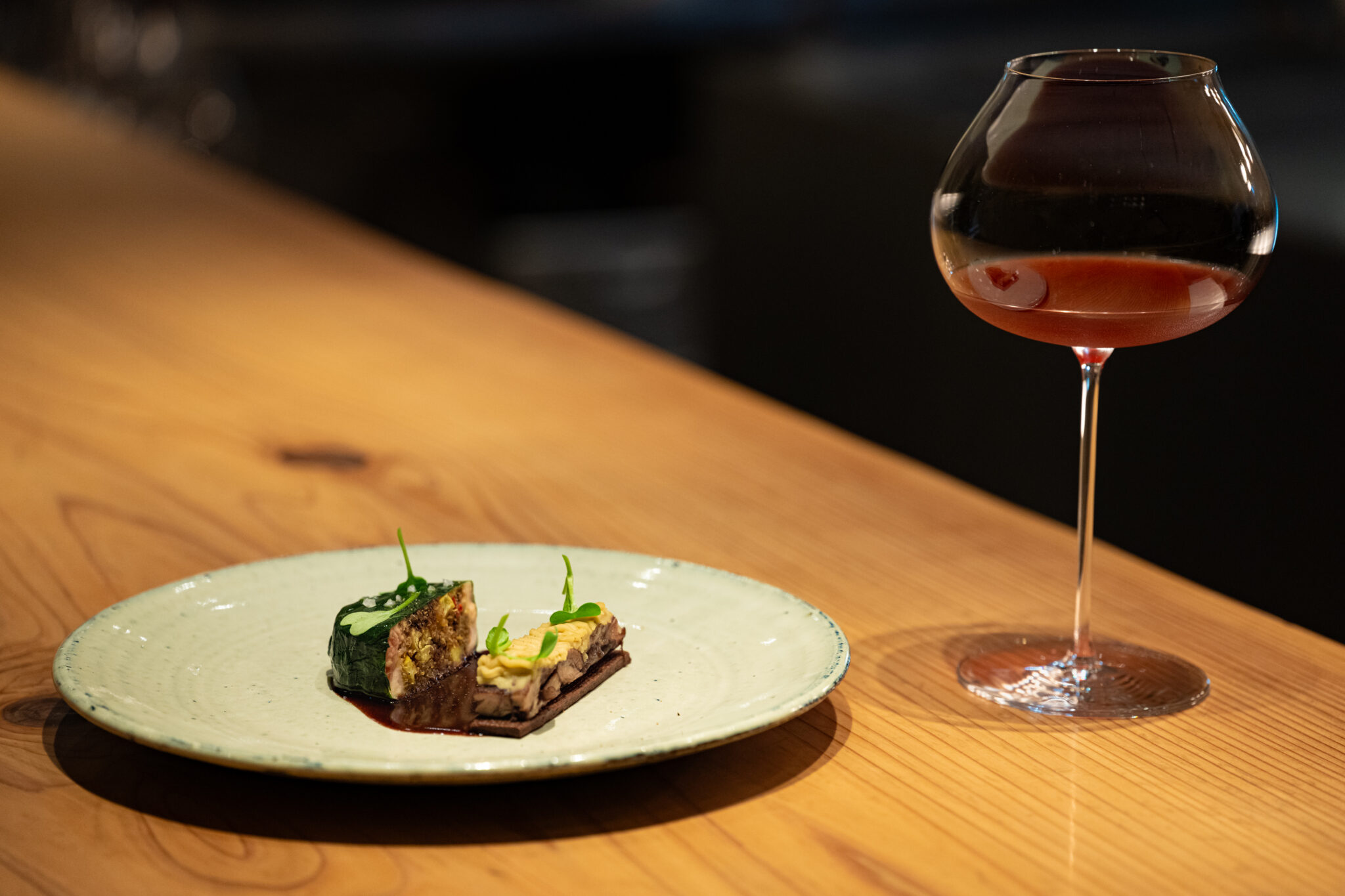
The ingredients used in the dishes for early November featured chicken breast simmered in a samgyetang (ginseng chicken soup) inspired broth with chestnuts, quinoa, goji berries, dried raisin and a tart-style coq au vin (chicken simmered in red wine) on the side. The chicken thigh was topped with a chestnut puree with a Mont Blanc-inspired finish. The rich and vibrant paired drink created a symphony that resonated in the palate.
Nakatsuka says, “Miyauchi is our restaurant’s strongest asset who we can rely on completely.”
“Ever since he joined us I feel that the quality of our pairings improved drastically. Rather than simply finding dishes and drinks that go well together, I aim to make dishes that become even better when paired.”
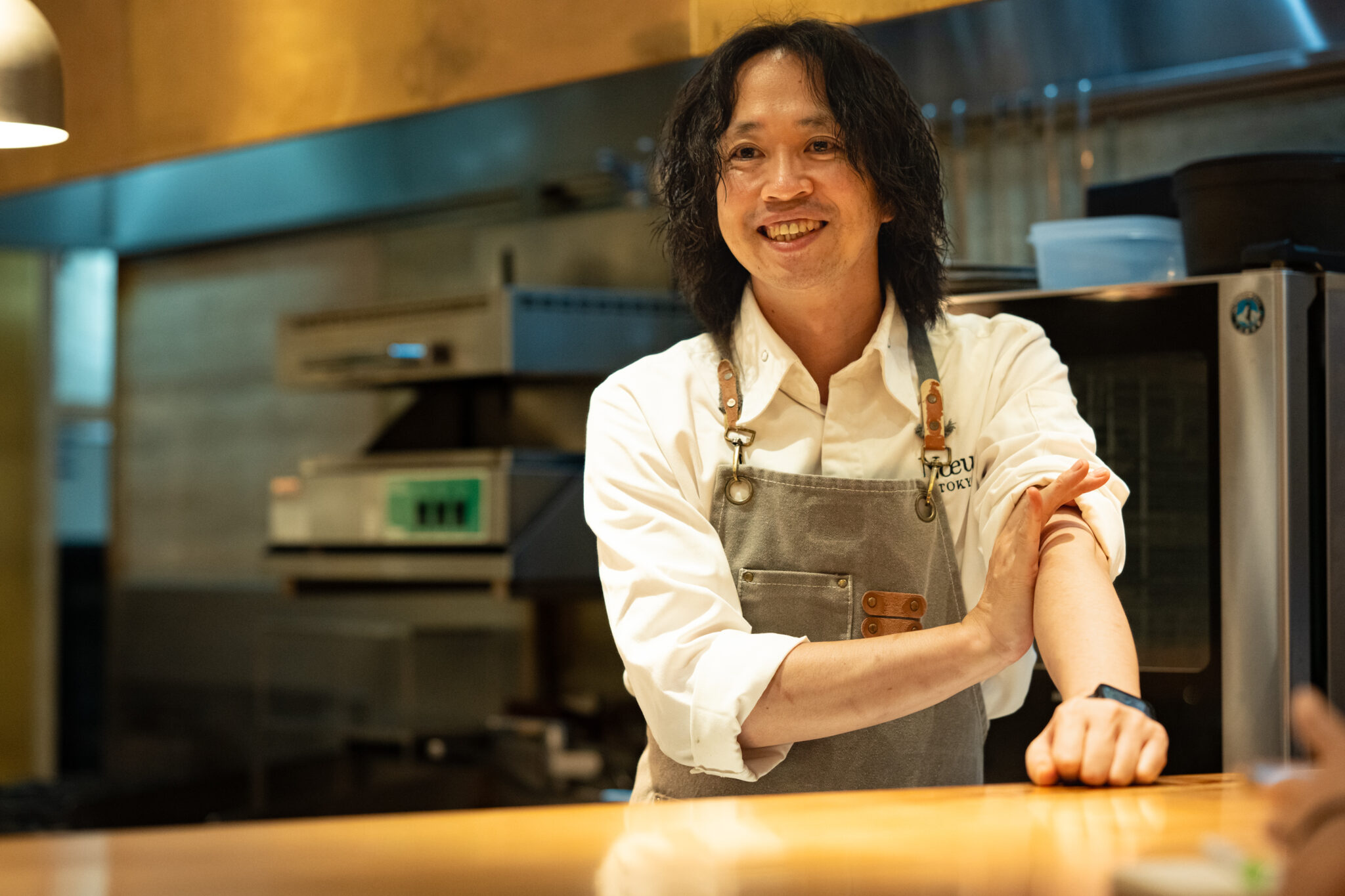
Miyauchi speaks modestly of his own abilities, saying that he is not a natural genius. His ideas for non-alcoholic drinks are born from daily dedication to his craft, and he often finds inspiration in the subtle nuances of wine.
“I trace the aromas I encounter in wine and hold a clear image of them in my mind. When I come across a particular scent, it often brings back the memory of a certain wine. It may differ from the traditional language of a sommelier, but I sometimes find the nuances of a mature white wine in ingredients such as fennel, anise, or saffron. I am always experimenting and slowly building my understanding, one day at a time.”
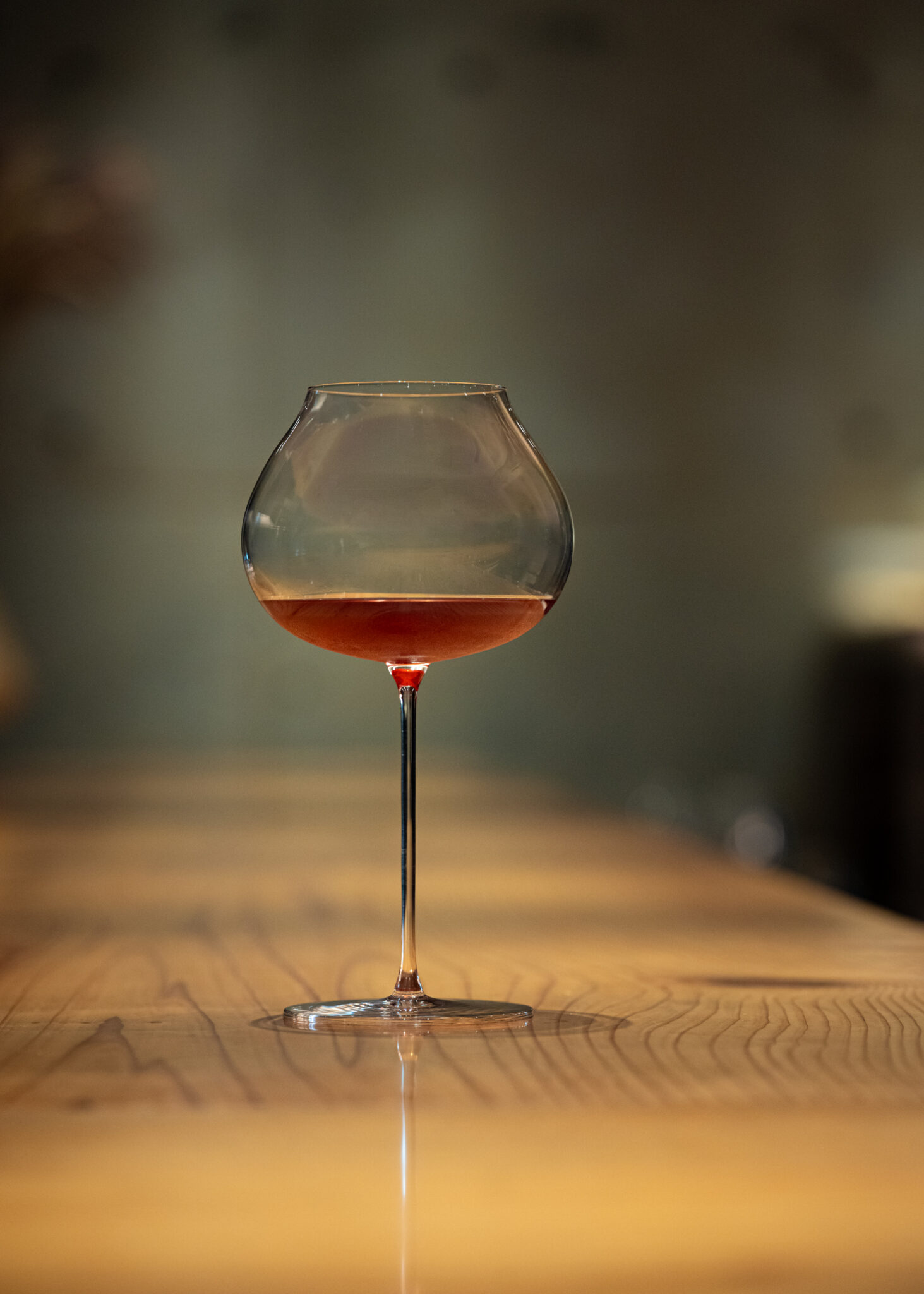
Although they cannot alter wine on their own, the non-alcoholic drinks allow them to freely refine and tune every detail.
“As a sommelier, creating your ideal drink and pairing is a different kind of joy than selecting the best wine to pair with the dish.”
“Being able to create and express what I personally find to be the most delicious on my own is incredibly fun.”
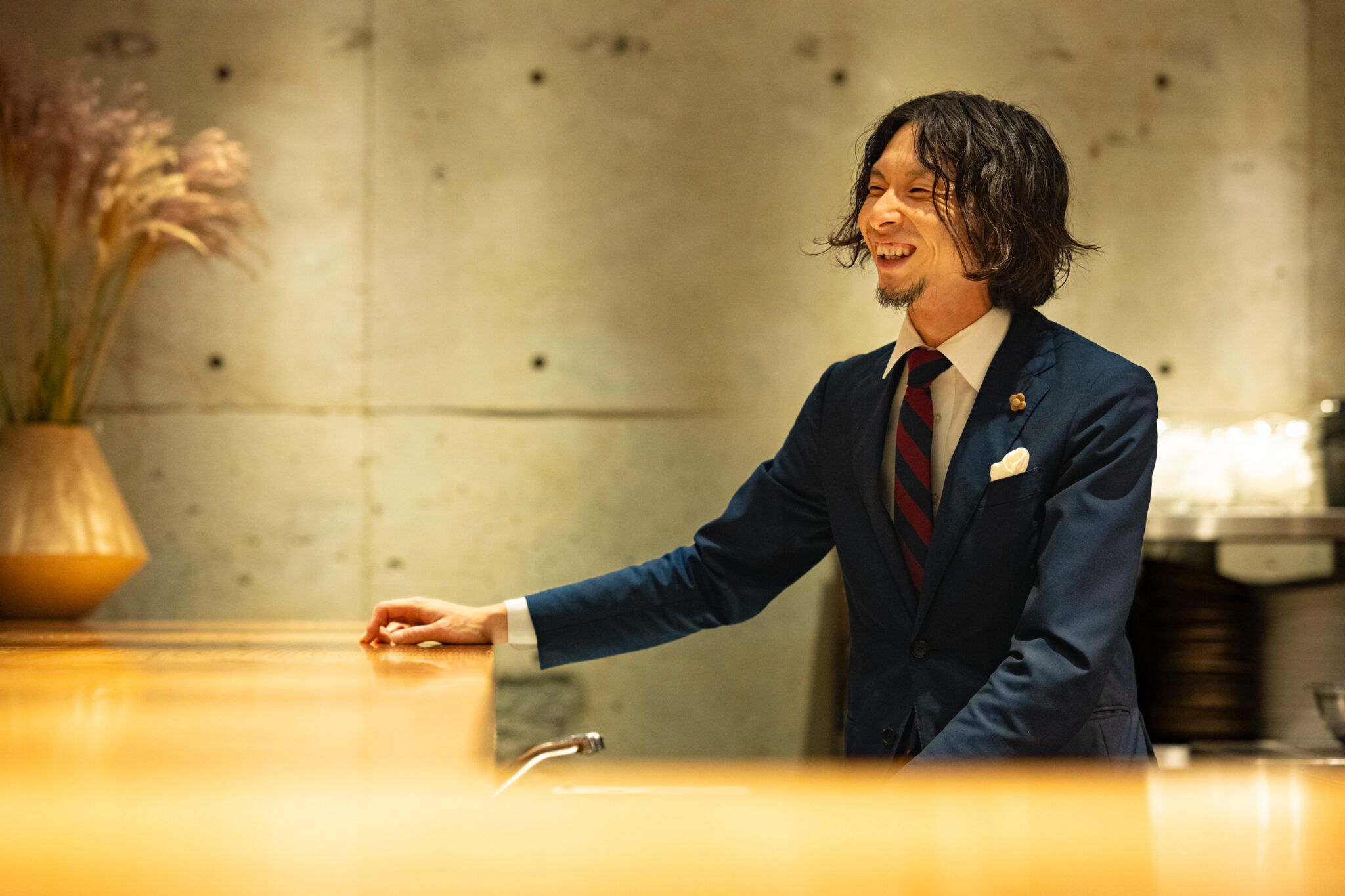
Nakatsuka says, “No matter who the guest is, if they leave without feeling happy about the dining experience, it simply does not feel right to me.”
“The word ‘restaurant’ comes from a root meaning ‘to restore’ or ‘to regain strength.’ Whether our guests are Japanese or from abroad, vegetarian, or even selective eaters, my sincere wish is for everyone to enjoy our food and leave feeling happy and energized.”
“I am naturally anxious, so when a dish is left unfinished, it affects me deeply. Even though we value sustainability, I do not believe a restaurant should impose its own ego or ideals on its guests. Ultimately, deliciousness matters most. I want to continue pursuing the true essence of what makes food delicious.”
Nakatsuka adds that he has no interest in becoming a famous chef. Instead, he cares deeply about his staff and the producers he works with, and he hopes the restaurant can serve as a vessel that connects people to their work.
“My hope is that we can create an exciting wave together, one that allows everyone involved to shine even brighter. To make that possible, I am always exploring new ways to share our work with the outside world.”
As Nœud.TOKYO continues to evolve, it is impossible not to anticipate what their creative cuisine and pairing experiences will offer in the years to come.
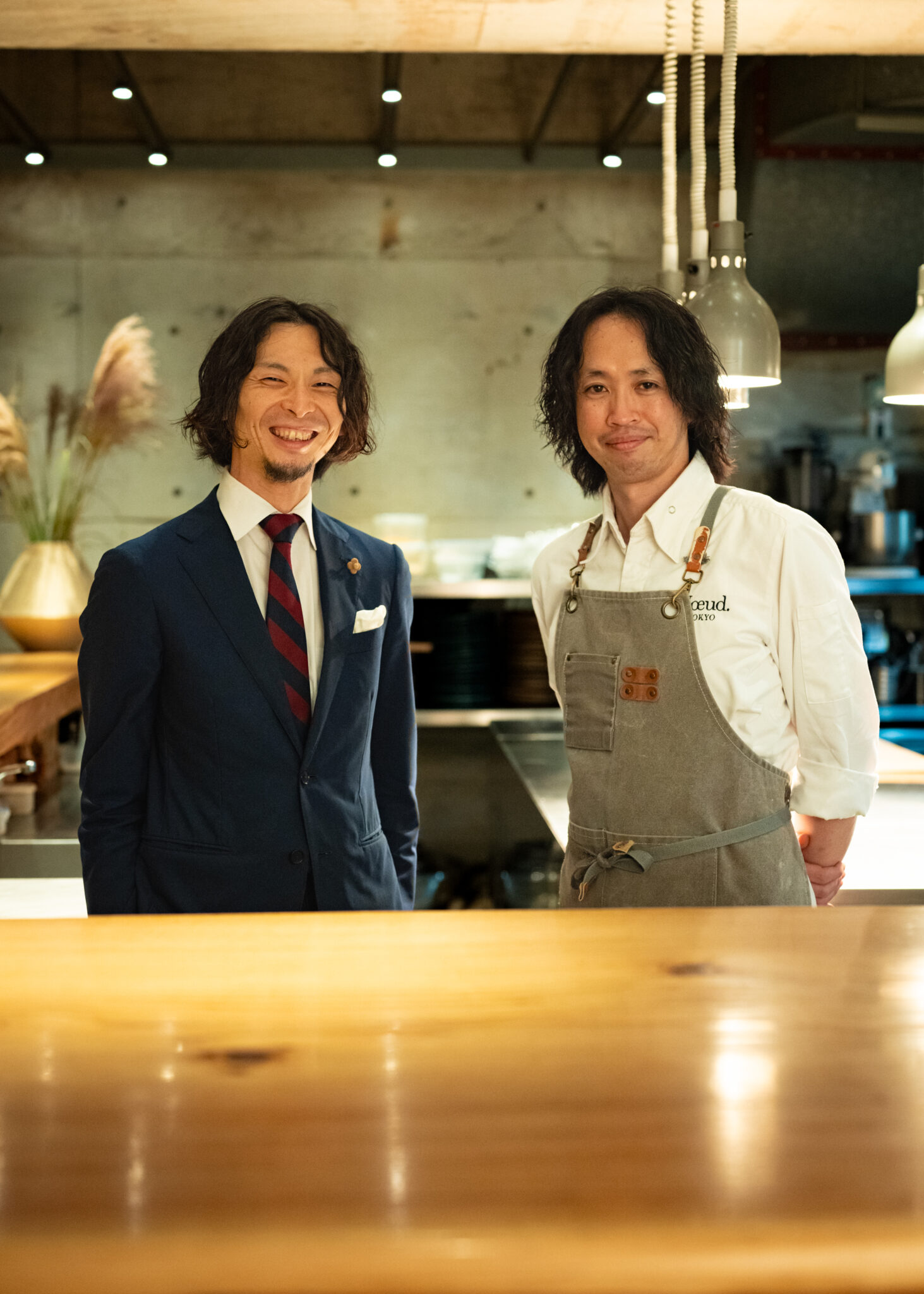
Nœud.TOKYO(ヌー・トーキョー)
Advisor to corporations, and local governments on promoting local tourism. Published work includes, “Aomori & Hakodate Travel Book” (Daimond), “San’in Travel: Craft and Food Tour” (Mynavi), “A Drunkard’s Travel Guide: Sake, Snacks, and Tableware Tour” (Mynavi). Her life work is to explore towns in her travels, drink at different shops and visit the workshops of different crafts. Interests include tea, the Jomon period, architecture, and fermented foods.
Editor and creator of the future through words. Former associate editor of Huffington Post Japan. Became independent after working for a publishing company and overseas news media. Assists in communications for corporates and various projects. Born in Gifu, loves cats.